Before cathedrals and mosques, before the cement of dogma covered the personal path to the Divine, there was an older way, a way of direct knowledge unmediated by priests, institutions, or imposed sacred texts; this is the forgotten legacy of European shamanism, the deepest root of our spirituality, a time when connecting with the sacred was an act of individual sovereignty.
What unites the various forms of contemporary shamanism are four fundamental pillars: trance journeys, communication with spirits, divination, and holistic healing. Analyzing the findings of our most remote past, from the Paleolithic and Neolithic periods, we find evidence of all four of these elements. Based on the above and other important observations, recent studies in archaeology, anthropology, and the history of religions converge on an interesting interpretation: in the Neolithic period, Europe was home to shamanic forms deeply similar to those that currently survive in Siberia, the Americas, and other parts of the world.
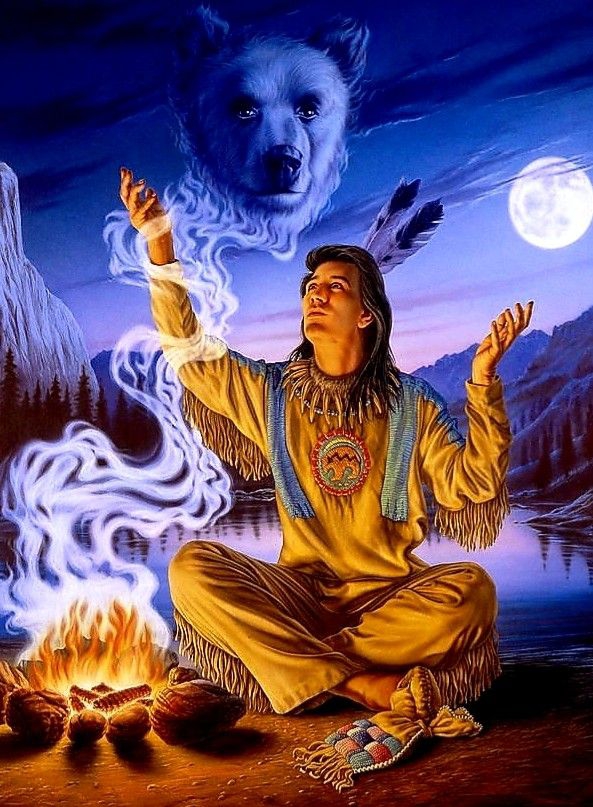
Trance was the shaman's main vehicle, the tool for forcing the gates of ordinary perception; this altered state of consciousness was achieved through the hypnotic rhythm of drums, dance, fasting, and the ritual use of psychoactive plants. The most significant evidence of the ancient practice of trance consists of images. In cave paintings and engravings, hybrid figures of men and animals can be seen representing shamanic transmutation, that moment when the individual transcends human form to take on the essence of an animal and travel to another reality.
Regarding communication with spirits, which often took place during trance journeys, we can say that according to ancient and current shamanic beliefs, the whole world around us is populated by spirits; animals, trees, places, rivers, mountains, are all living beings endowed with consciousness, and the shaman can be considered a mediator who reports the knowledge acquired from these spirits. Even in the Neolithic period, humans communicated with spirits, as evidenced by burials that included deer antlers or boar tusks alongside the deceased. These findings indicate the presence of a shaman whose spirit ally was that animal. Furthermore, statuettes of water birds, bears, or other animals found at various sites are representations of spiritual helpers.
As for divination, we can say that it is one of the oldest and most universal shamanic practices. In the Neolithic period, people sought advice for the future by interpreting the flight of birds, cracks in bones thrown into the fire, or the shapes of clouds.
The three practices I mentioned were used to obtain knowledge by means other than logical reasoning; then there were healing rituals involving herbs, songs, and energy manipulation; shamanic healing recognized the holistic nature of illness, the causes of which are often spiritual or emotional, rooted in an imbalance within the person themselves, with the community, or with the natural world.
Unlike institutionalized monotheistic religions, which have imposed dogmas, immutable divine laws, and celestial hierarchies that perfectly reflect those on earth, in the thousand forms of indigenous and tribal shamanism there are no dogmas to be accepted on faith or divine laws to be respected; spirituality is not a court of law but a journey. in this context, there is no hierarchical figure imposing a doctrine, no one has a monopoly on spirituality, there are shamans but they do not hold power over others, they transmit the knowledge they have acquired in trance, therefore without using logical reasoning.
With respect to those who believe that shamanic journeys are explorations of parallel worlds, my personal interpretation is more psychological. For me, these journeys are inner journeys, and the spirits encountered, such as power animals, are not external entities but expressions of parts of ourselves. They represent what we might call intuitive intelligence, a part of us that too often remains silent because it is suffocated by the frenzy of everyday life.
In light of the above, I believe that we modern pagans must take into account that original spirituality was very similar to the few remaining forms of shamanism. Therefore, in constructing our rituals, we can take inspiration from shamanic rites, but we must rework them with a contemporary perspective based on our current knowledge.
https://www.my101.org/discussione.asp?scrol=1&id_articolo=7476